
NeuroCore — Adaptive AI Processor IP.
NeuroCore is a proprietary compute architecture designed for adaptive, temporal and event-driven AI workloads, with recurrent processing, persistent local state and on-chip learning capabilities.
Licensed into customer ASICs, SoCs, and heterogeneous computing architectures, NeuroCore provides a differentiated compute primitive where continuous learning, sub-millisecond plasticity, and temporal context are essential.
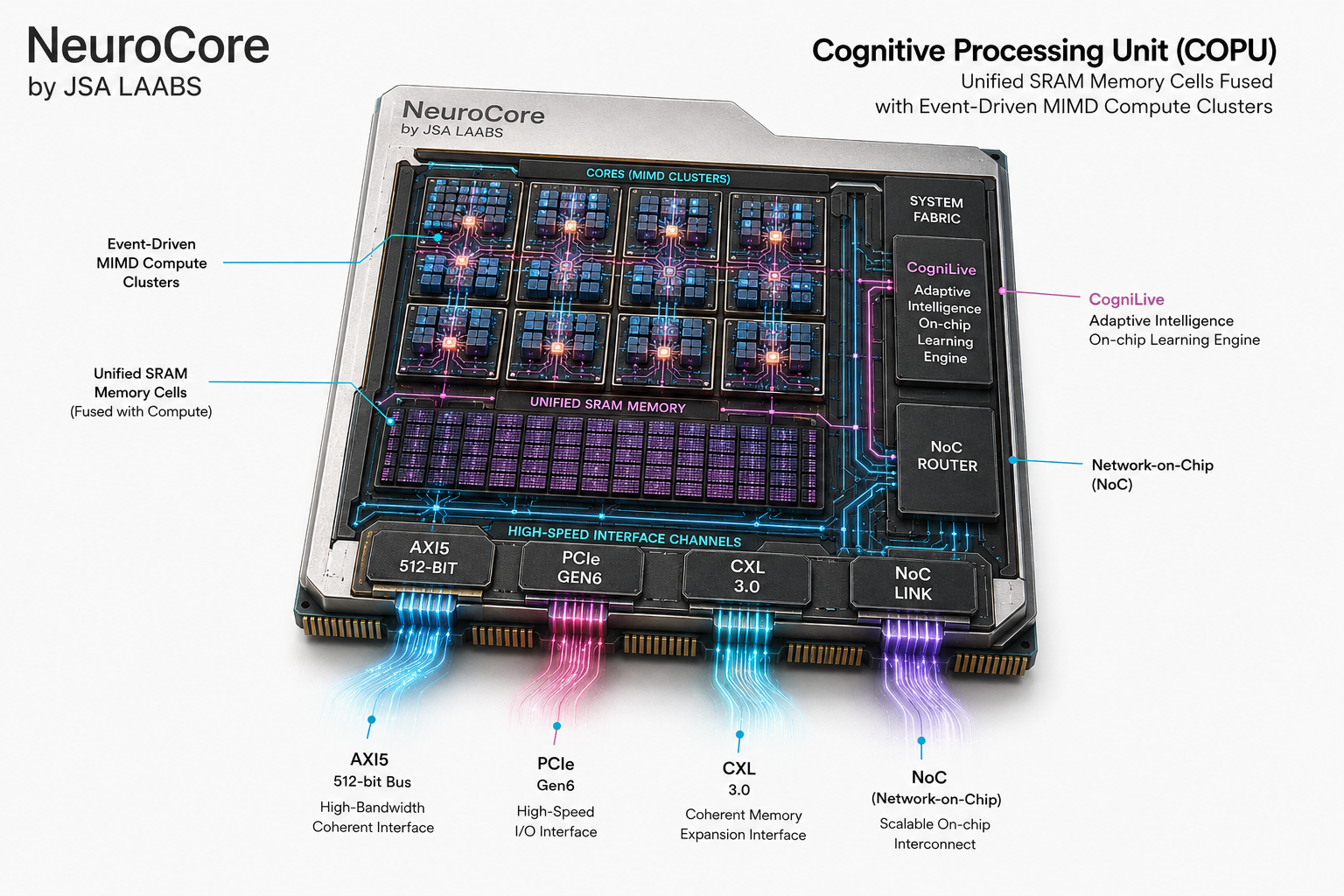
Fused SRAM & Event MIMD Core Topology
Unified memory cells fused directly with asynchronous compute clusters, the CogniLive local adaptation engine, and bus interconnect channels.
Five Core Architectural Foundations
Every layer of NeuroCore is designed around the computational requirements of non-stationary signals, continuous adaptation, and temporal sequences.
A. Adaptive Computation
Dynamic Representation & Parameter Updating
NeuroCore allows internal parameters and representations to update dynamically in response to shifting incoming data patterns and localized error signals. Unlike conventional static inference processors whose weights remain frozen post-compilation, NeuroCore adapts in-system during active deployment.
B. Temporal Processing
Recurrent State & Streaming Sequence Modeling
Engineered from the transistor level for continuous time-series and streaming sequence processing. Hardware-resident recurrent feedback loops maintain temporal dependencies directly within the core, allowing accurate sequence tracking without the computational quadratic scaling of standard attention mechanisms.
C. Local Learning
On-Chip Synaptic Plasticity (e-prop) vs. Global BPTT
Implements on-chip local learning mechanisms such as eligibility propagation (e-prop) and local synaptic plasticity. Weight updates are computed locally in space and time, completely avoiding the prohibitive memory buffering, backward passes, and latency bottlenecks of Backpropagation Through Time (BPTT).
D. Event-Driven Computation
Asynchronous MIMD Pipeline & Sparse Activation
NeuroCore operates on an event-driven paradigm where compute clusters remain completely dormant until activated by meaningful data events. This asynchronous MIMD structure achieves dramatic energy reductions in workloads characterized by natural temporal sparsity, such as sensor monitoring and intermittent telemetry.
E. Persistent Context
Multi-Second Hardware Memory & High Retention
Fused on-chip SRAM cells retain internal recurrent state across multi-second continuous operational horizons. Combined with dual-tier consolidation, NeuroCore maintains persistent context across tasks without requiring continuous external memory reads or suffering from catastrophic forgetting.
Designed to Become Part of Your Silicon.
NeuroCore is licensed as a functional processor IP core designed to connect smoothly into modern customer SoC fabrics, memory hierarchies, and heterogeneous compute environments.
Adaptive Coprocessor IP Block
Integrated alongside standard application processor cores (Arm / RISC-V) to offload real-time signal processing, anomaly detection, and local continuous adaptation.
Specialized Neural Subsystem
Incorporated as a dedicated neural accelerator tile connected via high-bandwidth on-chip AXI5 or NoC interconnects within advanced SoC designs.
Chiplet Accelerator Tile
Packaged as a modular compute chiplet interfacing with host compute fabrics via standardized die-to-die interfaces (UCIe / custom interfaces).
Edge Sensor Processing Subsystem
Synthesized into ultra-compact ultra-low-power microcontrollers for always-on biometric, industrial, and automotive sensor hubs.
Standard Interface & Interconnect Compatibility
NeuroCore includes configurable bus interface controllers and wrapper bridges to interface seamlessly with customer on-chip fabrics.
AXI5 Interconnect
High-bandwidth on-chip
PCIe Gen6 Controller
Host accelerator bus
CXL 3.0 Protocol
Cache-coherent fabric
On-Chip NoC Router
Multi-tile scaling
UCIe / Chiplet PHY
Modular packaging
SPI / UART / GPIO
Embedded sensor front-ends
* Interface implementations are delivered as synthesizable protocol wrappers or mapped to customer-selected third-party PHY/controller IP blocks.
Standard IP Deliverables Package
Evaluate NeuroCore for Your Next Silicon Program
Speak with our processor architects to review simulation models, workload profiling, and integration requirements.