
NeuroCore Core Architecture.
A deep technical evaluation of JSA LAABS' proprietary event-driven MIMD processor IP: internal pipeline stages, fused SRAM memory cells, hardware-resident e-prop synaptic learning, and SoC bus interconnects.
NeuroCore Processor Core Topology
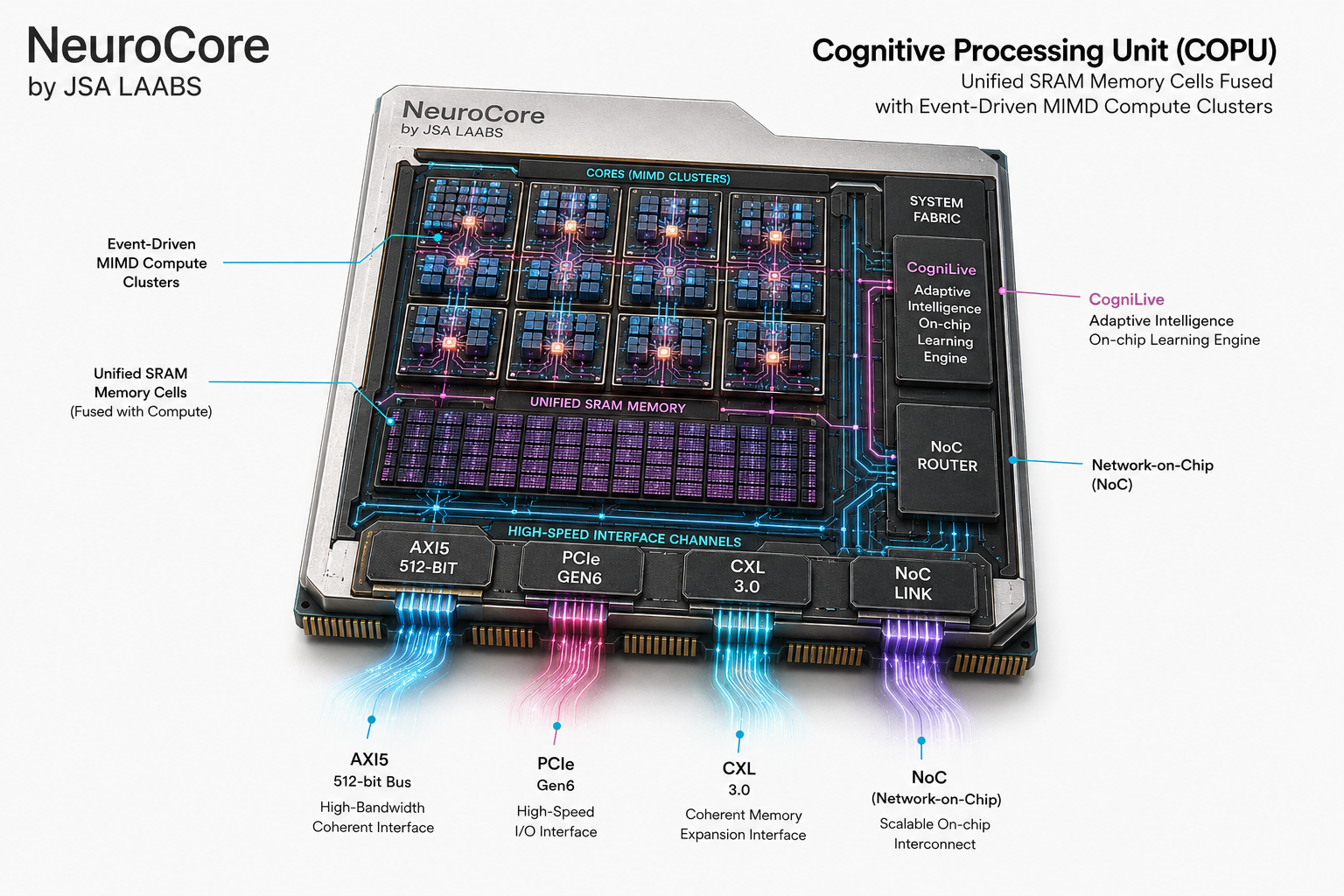
Detailed Architectural Walkthrough
Select a subsystem to review its microarchitectural pipeline, register flow, and verification characteristics.
Event-Driven Asynchronous MIMD Cluster
CORE LOGICUnlike conventional SIMD/SIMT architectures (such as GPUs) that force identical instructions across wide lockstep warps, NeuroCore utilizes a Multiple Instruction, Multiple Data (MIMD) structure. Each processing element operates independently on its local event stream.
Zero Idle Clocks
Execution units shut down via aggressive asynchronous clock-gating when input event queues are empty, virtually eliminating dynamic idle power dissipation.
Event Dispatch Unit
A hardware event arbiter routes incoming spikes and temporal tokens directly to target neurons without requiring software OS polling or CPU interrupts.
Configurable Precision
Supports configurable integer and fixed-point precisions (INT8, INT16, and BF16 modes) tailored to customer power-performance-area (PPA) targets.
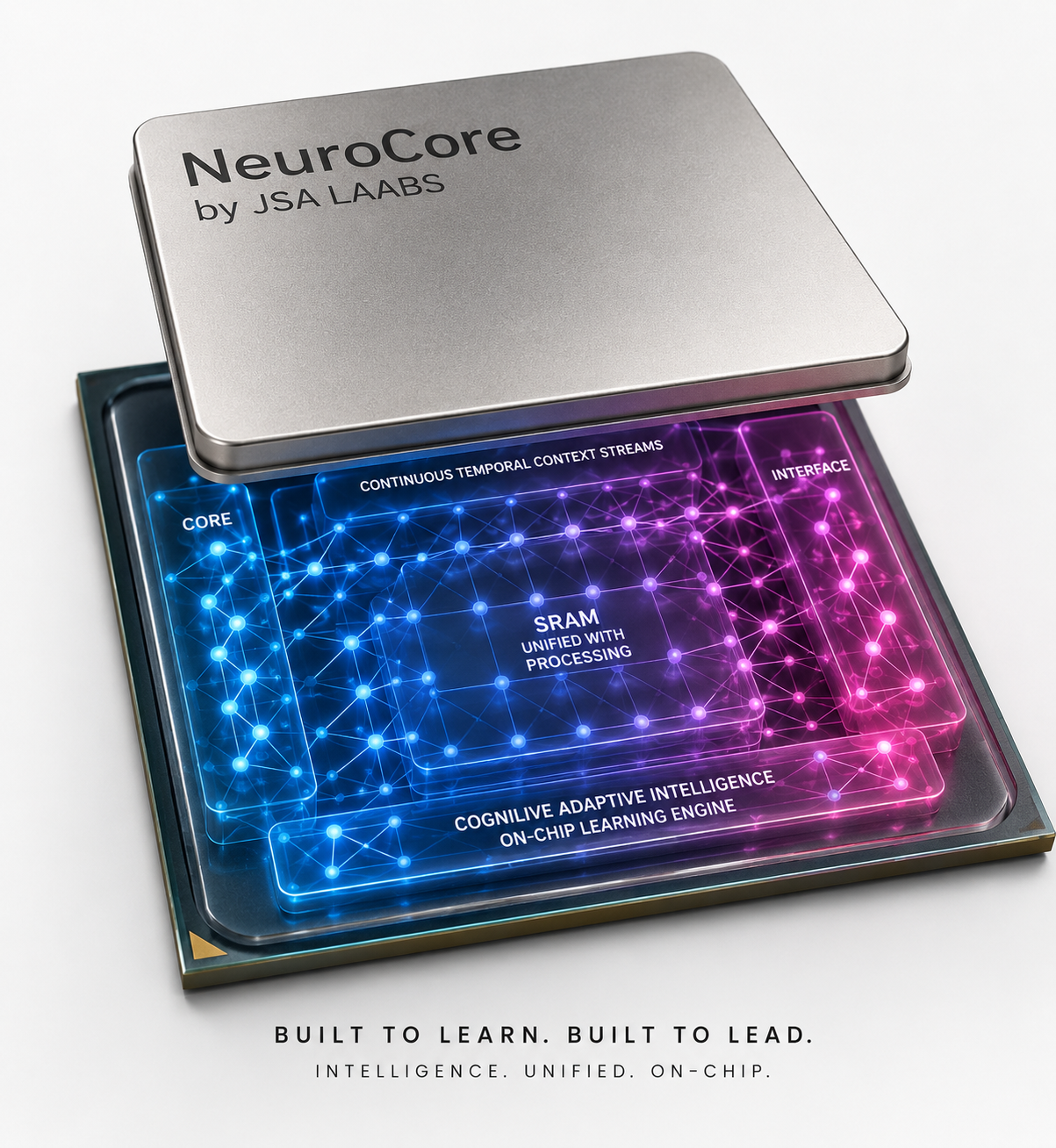
Second-Long Timescale Context Pipeline.
World Models and Joint Embedding Predictive Architectures (JEPA) require continuous internal physical state representations across non-trivial time horizons.
NeuroCore maintains continuous temporal state trajectories directly within fused silicon registers, allowing predictive state estimation without relying on bulky external KV caches.
Temporal Pipeline Highlights:
• Multi-second timescale internal state persistence in fused registers.
• Predictive latent-state updates driven by incoming prediction error signals.
• High retention: <0.8% degradation across 50 sequential benchmark tasks.
Request Architectural Whitepaper & Integration Specs
Detailed register maps, clock domain crossing topologies, and synthesis collateral are available to qualified semiconductor engineering teams under NDA.